
My father was able to calm down after moving the family back to Portland, Oregon. From here on out he would often be gone for extended temporary duty assignments (TDY). But, when he was home he was occasionally the man I wanted to remember but mostly the man I do not. He absences were so pronounced that in our little town that father was believed to have abandoned the family! And when he was around it was not pleasant on my backside, punishments were meted out whether earned or not. Something was really wrong with him internally, I was to realize as an adult.
Every summer, I would be able to go stay with my great uncle, whom I still admire and have to give him the nod for being the major contributor in forming my inner values. He was my real father, the man whom visited our family I no longer knew.
Of course, my great uncle was ancient and only lived until I was 10 but those were important years for me.
If from father I learned to appreciate opera and Wagner, hiking and nature, the stars and space. Then from Leonard I learned fishing, boat building, self subsistence, dairy herd management and everything there is to know about chickens. But, he also taught me about wealth, generosity, helping the poor and honoring the dead.
Yeah, between the two of them I was shaped to understand technology and dream, as well as, to have my boots ground in the cow-pies and how to milk a cow. Combined, this created a bit of a challenge for my future teachers......
Monday, October 25, 2010

Tuesday, October 19, 2010
Back Home
This part has now been rewritten several times. It is hard to write this part and not say what I have promised myself not to say..... So, long post has been mostly parred down:
What was to follow for father was now to spend the next several years in some special classes to catch him up to date with the state of the art in mass destruction. To do that he was sent down to Sandia Labs, as well as, Lawrence Livermore Labs. And though I was but a small boy, I remember those labs well - which would be much to the shock to everyone whom just wrote me off as "that curious toddler".
Yeah, I can remember those years very well, the odd characters whom floated in and out of that creative scientific community. But the names are long gone.
My strongest memory was of one of the scientists whom always carried a spare zipper in his pocket. When some particularly interesting problem was poised, he would dig out that zip and just zip and un-zip it! "Kris, notice this zipper, how the teeth fall together with such ease. How could someone have conceived of something so simple and yet so strong in holding our pants together ..."
And there was another scientist I remember whom loved reptiles and always had one in one of his pockets to play with while he thought.
Yeah, they were an odd bunch, but they loved having me around and all of those meetings were stored in my memory, which would bite me later in life. But, although I might remember them, I could in no way understand until I was much older.
:^)
What was to follow for father was now to spend the next several years in some special classes to catch him up to date with the state of the art in mass destruction. To do that he was sent down to Sandia Labs, as well as, Lawrence Livermore Labs. And though I was but a small boy, I remember those labs well - which would be much to the shock to everyone whom just wrote me off as "that curious toddler".
Yeah, I can remember those years very well, the odd characters whom floated in and out of that creative scientific community. But the names are long gone.
My strongest memory was of one of the scientists whom always carried a spare zipper in his pocket. When some particularly interesting problem was poised, he would dig out that zip and just zip and un-zip it! "Kris, notice this zipper, how the teeth fall together with such ease. How could someone have conceived of something so simple and yet so strong in holding our pants together ..."
And there was another scientist I remember whom loved reptiles and always had one in one of his pockets to play with while he thought.
Yeah, they were an odd bunch, but they loved having me around and all of those meetings were stored in my memory, which would bite me later in life. But, although I might remember them, I could in no way understand until I was much older.
:^)
Monday, October 11, 2010
Spies Like Us
 |
| 55,000 in this Protest |
Much of the blame for the two uprising in Hungary and later in Czechoslovakia can be blamed directly on Radio Free Europe - they openly encouraged citizens of those two countries to rise up in revolt, even promising US aid - which was never to come. It was just a political ploy to give the Soviets a headache - and those games killed a great many innocent people whom trusted the radio voices.
 |
| No Russian Sense of Humor |
Back in Iceland, father had been blinded in an explosion. No real idea what he could have been doing that time! He was blinded for a while but when as his sight returned he had to wear glasses to correct for the permanent damage. He really hated those glasses but seeing is a nice activity. He was issued a pair of normal everyday PINK military framed glasses. I never could understand why the US military would only issue pink frames - like it was most men's favorite color? Gees! They were horrid.
 |
| Father in Budapest. |
So, although officially in Iceland for several more months, he was also on the world stage playing spy. And if you think of it, what are the odds you are going to be where you are not supposed to be - and end up getting photographed in the wrong place, at the wrong time, by a photo-journalist? Makes you wonder.
It also was the first hint that maybe there was a great deal I did not know about father.....
Monday, October 4, 2010
Reunion
 |
| Road To Keflavik |
Actually, the base was loaded with ex-Germans at this time. The official reason? To do paperwork searches on each of them to confirm their role(s) in WWII. Oh ouch! For father this was going to be trouble now.

 |
| No Shorts in Summer? |
But, as you will shortly find out: they were to be risking their lives in ways they never would have thought possible.....
Monday, September 27, 2010
The Subject of Religion
This is the appropriate time to discuss father and his religious beliefs. Why? Because you have to remember earlier I told you about father converting to Judaism before marrying Monika, the young female prisoner he had met while interned at Wöbbelin. So father was circumcised and this knowledge may have lead to a mis-identification of him by the US military.
To the US Military they had a quandary on their hands. Father was known to have escaped from the advancing Russians, placing him on the east side of the Elbe River. He was Jewish, that was obviously apparent from his medical examination. Jewish, eastern Europe, survivor. That pretty limited him to Nordhausen or Mittelbau. But, was it possible to have escaped the SS carnage the US Army had discovered before the Russians had advanced on the Mittelbau complex? This also meant he was a scientist or at the least science labor. He had to have been familiar with the rocket programs. So, his enigmatic past drew attention to him he really did not want. Could it be there was anyone whom could be found whom knew him before his marriage to mother?
Father was really born into a Lutheran family in the small town of Munchstein, in Baslestadt, Switzerland. The year he ran away from home, to join the Nazi cause, was also the year he went through Lutheran confirmation. His family, and the church's pastors, all believed father was destined to join the priesthood.
Those Lutheran beliefs were obviously killed by the war - he saw what Lutherans were capable of - first hand. His conversion to Judaism I am fairly certain was completely based on his sense of national and personal guilt. What happened in the concentration camps was to have quite an impact on all of Germany and all whom I grew up with. (And, yes, I understand that it was not the Lutherans whom were running the Nazi Party, but this was HIS take on the situation! In truth, 7.5 million Christians were sent to the concentration camps for opposing Hitlers agenda.)
Father still held to his Judaism. When I was born he personally brought in a Rabbi from Sacramento, California to see to my circumcision, on the eighth day, as required. I was unable to be taken out the hospital for the first several months of life. Babies of extra young mothers have a great many challenges in just surviving.
As I grew up, father taught me the Law of Moses, how to pray - in Yiddish, God's language of course!, and with a firm understanding that there is God - but you really do not want to know Him since he is not a very good god to his people. I should say that part was beaten into me more than anything.
As I grew older, into teenage hood, father and mother clashed more and more over religion and food, eventually this brought about their divorce. But we can look into that episode much later!
Following his divorce from my mother, father became an outright atheist. Except he knew there was a God, he just did not what any part of him any longer. So, perhaps it would be best to categorize father as a gnostic for the final fifty years of his life. And, my becoming a Christian was about the final straw for him concerning me.....
To the US Military they had a quandary on their hands. Father was known to have escaped from the advancing Russians, placing him on the east side of the Elbe River. He was Jewish, that was obviously apparent from his medical examination. Jewish, eastern Europe, survivor. That pretty limited him to Nordhausen or Mittelbau. But, was it possible to have escaped the SS carnage the US Army had discovered before the Russians had advanced on the Mittelbau complex? This also meant he was a scientist or at the least science labor. He had to have been familiar with the rocket programs. So, his enigmatic past drew attention to him he really did not want. Could it be there was anyone whom could be found whom knew him before his marriage to mother?
Father was really born into a Lutheran family in the small town of Munchstein, in Baslestadt, Switzerland. The year he ran away from home, to join the Nazi cause, was also the year he went through Lutheran confirmation. His family, and the church's pastors, all believed father was destined to join the priesthood.
Those Lutheran beliefs were obviously killed by the war - he saw what Lutherans were capable of - first hand. His conversion to Judaism I am fairly certain was completely based on his sense of national and personal guilt. What happened in the concentration camps was to have quite an impact on all of Germany and all whom I grew up with. (And, yes, I understand that it was not the Lutherans whom were running the Nazi Party, but this was HIS take on the situation! In truth, 7.5 million Christians were sent to the concentration camps for opposing Hitlers agenda.)
Father still held to his Judaism. When I was born he personally brought in a Rabbi from Sacramento, California to see to my circumcision, on the eighth day, as required. I was unable to be taken out the hospital for the first several months of life. Babies of extra young mothers have a great many challenges in just surviving.
As I grew up, father taught me the Law of Moses, how to pray - in Yiddish, God's language of course!, and with a firm understanding that there is God - but you really do not want to know Him since he is not a very good god to his people. I should say that part was beaten into me more than anything.
As I grew older, into teenage hood, father and mother clashed more and more over religion and food, eventually this brought about their divorce. But we can look into that episode much later!
Following his divorce from my mother, father became an outright atheist. Except he knew there was a God, he just did not what any part of him any longer. So, perhaps it would be best to categorize father as a gnostic for the final fifty years of his life. And, my becoming a Christian was about the final straw for him concerning me.....
Monday, September 20, 2010
Joining The Military
So, for whatever reason, the sandwich shop failed and father took his friend's advice and joined the military. I do not know where his basic training was at but I do know that mother went back to live with grandmother on the houseboat opposite Swan Island in Portland.
 Having completed his basic training, father was stationed temporarily at a base in California - where I was then born. Under the US laws I was born under, if your father was foreign and you were born on Federal property - not US soil - you were not granted automatic citizenship. So, I was born a German citizen, since this was father's nationality at the time. The state of California, wondering how to register the birth, ended up issuing me a permanent voter's registration card! But, no birth certificate. The hospital on the base issued me a live birth card, stipulating me foreign born - and a female. (Thank you, you worthless military typist!)
Anyways, that little distinction - Federal property - not US soil, was to haunt me until I was 20, when I finally went through naturalization - even though I WAS a US citizen according to the US agreement father signed. So, that closed that problem, mostly!
 Probably the greatest of father's inabilities was the lack of knowledge as to how people behave. He judged all by the standard of himself and though he was a world class liar, he was never sneaky. A very odd combination. You could not trust his words but you could his motives and actions. If your life was in his hands, he would lose his first to save you (not me, I'm the troubled son, remember?). Weird.
So, had father of been of just even average knowledge concerning human behavior, he would have looked at his first post and wondered - "Why am I here?" Why would a foreign national have immediate access to weapons of mass destruction? Had he of thought about it - he would have realized he was being tested and set up for the next step in the devious US plot to draw him out into the open.
But, in any event, father was shortly to find himself in hot water with the US Government. We can call this one Cold War paranoia, however this time it was for all Germans in the US employ.....
And, I now am at a bit of a breaking point. So far I have been fairly free to write about father's life - however, his work for the US Government was very hush-hush and I have no desire to go through yet ANOTHER citizenship hearing, with the threat of being deported - again! So, we will ignore a great deal of father's professional life. Sorry, I am not going to tell you how to build weapons of mass destruction - go to the library and read up on it, everybody else does. Though you may find that libraries are more accessible on such subjects in other countries than in the US....

Anyways, that little distinction - Federal property - not US soil, was to haunt me until I was 20, when I finally went through naturalization - even though I WAS a US citizen according to the US agreement father signed. So, that closed that problem, mostly!

So, had father of been of just even average knowledge concerning human behavior, he would have looked at his first post and wondered - "Why am I here?" Why would a foreign national have immediate access to weapons of mass destruction? Had he of thought about it - he would have realized he was being tested and set up for the next step in the devious US plot to draw him out into the open.
But, in any event, father was shortly to find himself in hot water with the US Government. We can call this one Cold War paranoia, however this time it was for all Germans in the US employ.....
And, I now am at a bit of a breaking point. So far I have been fairly free to write about father's life - however, his work for the US Government was very hush-hush and I have no desire to go through yet ANOTHER citizenship hearing, with the threat of being deported - again! So, we will ignore a great deal of father's professional life. Sorry, I am not going to tell you how to build weapons of mass destruction - go to the library and read up on it, everybody else does. Though you may find that libraries are more accessible on such subjects in other countries than in the US....
Monday, September 13, 2010
Return To America
It is now fall of 1953. My mother had successfully raised the $100 to have father allowed back into the US and father, under who knows what pretense, leaves his now pregnant wife and returns to America. (Of course, this instantly raises the thought of father being a "dirty double crosser", since he crossed the Atlantic Ocean a second time to return to America. And, a double entandre as well it would seem.....)
Back in Portland, he needed employment and went to work at a sandwich shop near the train station I believe. Though this is where a bit of a conflict comes up as he claimed later in life that he had owned the sandwich shop and went bankrupt later on. This might be true however, but no matter which - the US Government now had him pegged as to whom he was and the wheels were quietly in motion to suck him to their employment. Very innocently, the man whom had been father's INS case worker during his deportation jail time and trial, looked father up, was to become his best friend and gently guide father in the direction the government wanted. It was almost Machiavellian how it worked out. And though he was a family friend, even to a small child as I was, I could plainly see that there was an agenda being played - but then again, I needed to be an adult to understand why what happened, actually happened.
 So father married the now 15 year old girl he had saved two years earlier and blam! she was pregnant. Well, now father needs to do something because there is a family coming along and lots of expenses. His new best friend sells him on the idea of joining the US Military - free medical, good income, career training, blah, blah, and blah.
This was so contrived you will not believe what happened next and father did not suspect a thing - ".....it had to have been circumstance.....". After all, father (like most liars) believed he was smarter than everyone else ... Unfortunately, that was both true and his eventual undoing.
 | |
| Father with a customer at the Duncet |

This was so contrived you will not believe what happened next and father did not suspect a thing - ".....it had to have been circumstance.....". After all, father (like most liars) believed he was smarter than everyone else ... Unfortunately, that was both true and his eventual undoing.
Tuesday, September 7, 2010
Return To Germany
During father's free time in Portland, Oregon, he spent most of it visiting with mother's family on the houseboat. Grandmother thought him charming and often commented in her later years that he was quite the "talker", ie: "real smooth". Mother's brothers all hung with him and probably appreciated the male companionship, as their father had left them when they were all young. As for mother, well, if she had been mine, it would have been over the knee with her!
She is now 14 years old and decided that my father was "it" and father had no problems with that idea. But, he was after-all up for deportation.....
So, father was returned to Germany and faced court-martial hearings for his part in the mutiny of the SS Riviera. In the end, the court ruled the mutiny to have been justifiable - however, his role as the leader of the mutiny was found to be inexcusable - he was after-all a German officer. He was stripped of his captain's rank and removed from the seaman's listing. So, he would never sail again. It is interesting to note that they also had the power to remove his German Naval rank of Captain and did not do so. Which he spoke of with pride - at their backhanded approval of what he did.
Father returned to Buchholtz, to his wife Monika, Fritz and Irma. It must have been some reunion since my half-sister Martha was born in 1954. As to whatever happened in Buchholtz, father would never say. Fritz and Irma continued in their role as his friend and members of his "family". Monika was to continue to write him weekly for decades - leaving me to assume he was writing her back. And, again, one must remember that there was no divorce filed I could find in the German archives. Did father turn over his bank account to her to keep her happy? Even in his 80's he was still harping about having "lost" all of his money. Makes one wonder what the real truth was.....
Back in Portland, mother set herself to raising the $100 immigration fee for allowing father back into America - she was determined to get her "man". And let me tell you, when I found that out, me and Grandmother had a very long talk about where she had failed with my mother. But, what I did not know was that mother was - uhm - a bit of a problem child it seems.
She is now 14 years old and decided that my father was "it" and father had no problems with that idea. But, he was after-all up for deportation.....
So, father was returned to Germany and faced court-martial hearings for his part in the mutiny of the SS Riviera. In the end, the court ruled the mutiny to have been justifiable - however, his role as the leader of the mutiny was found to be inexcusable - he was after-all a German officer. He was stripped of his captain's rank and removed from the seaman's listing. So, he would never sail again. It is interesting to note that they also had the power to remove his German Naval rank of Captain and did not do so. Which he spoke of with pride - at their backhanded approval of what he did.
 |
| Father with Edi and Udi in Buchholz |
Back in Portland, mother set herself to raising the $100 immigration fee for allowing father back into America - she was determined to get her "man". And let me tell you, when I found that out, me and Grandmother had a very long talk about where she had failed with my mother. But, what I did not know was that mother was - uhm - a bit of a problem child it seems.
Tuesday, August 31, 2010
Internment, Again
So father and the surrendered German sailors were held in the Portland city jail for the mutiny. At some point, the city attorney figured out that Portland could not charge anyone with mutiny - which comes under international sailing law. But, the police did not want the German's released, so they turned the prisoners over to the Immigration and Naturalization Service, whom then held them for illegal entry into the United States (the act of diving off of the ship!). Which the Oregonian had a hay day with!
It turns out that father and five others could conceivably be charged with illegal entry. However, it was in the rescue of US citizens and a public relations nightmare for the Portland INS office. They were besieged with calls demanding the release of the German sailors.
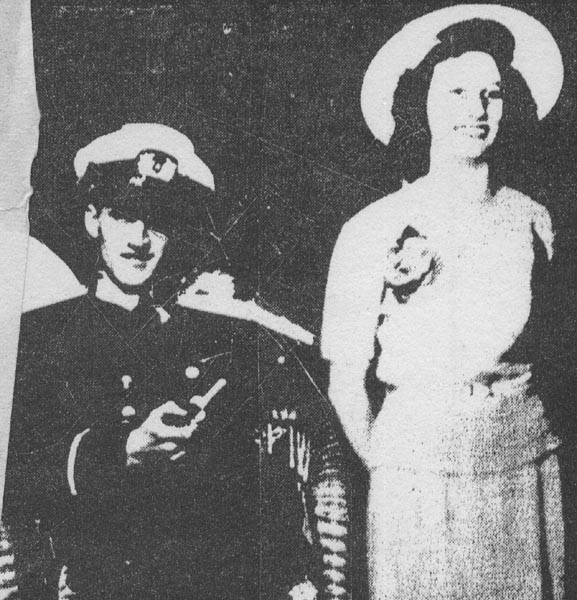
 At some point during this internment process, the Oregonian was able to bring enough public pressure on the INS that they released my father for a photo opportunity at the request of the newspaper, for one day. So, father was taken over to my grandmother's houseboat for a day with the Americans and the 13 year old girl he had saved (my mother).
This photo is from the original newspaper clipping my grandmother saved. However, the article has been lost. It would have been interesting to know what it said they all did that day! Other than have lunch.
In any event, this is one of the few photographs of father in his German officer's uniform and his ubiquitous pipe. Trimmed from the picture was the fact that he was wearing slippers as the INS would not allow the Germans to wear shoes since it was still thought they would run if given the opportunity. At the end of the day, the Germans involved in the rescue were returned back to INS for holding.
After several months of being held, the agent, family friend Bill White whom was in charge, managed to negotiate a release during the daytime for the Germans. After all, they had actually done nothing wrong and were model prisoners (compared apparently to others in the jail!). And, then there was the whole problem of the press not letting the story die. Father apparently spent most of his free time with grandmother's family and I have numerous pictures of him and my teenage uncles goofing off.
But, let us not forget the lawyers - whom were busy little beavers in the background. The strike was to be broken when the courts ruled that since there was no agreement between the US and German Seaman's Unions, the US longshoremen were involved in an illegal strike and ordered back to work. Completion of the inspection satisfied the insurance company so the ship could be released for repair and reloaded for return to India. The courts ruled that with no physical evidence concerning the death of the German sailor, and with no evidence of lack of provisions aboard the ship, the German sailors were deemed 'dissatisfied' and the owner ordered to return the sailors to their harbor of departure, to compensate them for their wages and release them from employment.
Father, however, was to be returned to Germany in chains.
It turns out that father and five others could conceivably be charged with illegal entry. However, it was in the rescue of US citizens and a public relations nightmare for the Portland INS office. They were besieged with calls demanding the release of the German sailors.
This photo is from the original newspaper clipping my grandmother saved. However, the article has been lost. It would have been interesting to know what it said they all did that day! Other than have lunch.
In any event, this is one of the few photographs of father in his German officer's uniform and his ubiquitous pipe. Trimmed from the picture was the fact that he was wearing slippers as the INS would not allow the Germans to wear shoes since it was still thought they would run if given the opportunity. At the end of the day, the Germans involved in the rescue were returned back to INS for holding.
After several months of being held, the agent, family friend Bill White whom was in charge, managed to negotiate a release during the daytime for the Germans. After all, they had actually done nothing wrong and were model prisoners (compared apparently to others in the jail!). And, then there was the whole problem of the press not letting the story die. Father apparently spent most of his free time with grandmother's family and I have numerous pictures of him and my teenage uncles goofing off.
But, let us not forget the lawyers - whom were busy little beavers in the background. The strike was to be broken when the courts ruled that since there was no agreement between the US and German Seaman's Unions, the US longshoremen were involved in an illegal strike and ordered back to work. Completion of the inspection satisfied the insurance company so the ship could be released for repair and reloaded for return to India. The courts ruled that with no physical evidence concerning the death of the German sailor, and with no evidence of lack of provisions aboard the ship, the German sailors were deemed 'dissatisfied' and the owner ordered to return the sailors to their harbor of departure, to compensate them for their wages and release them from employment.
Father, however, was to be returned to Germany in chains.
Tuesday, August 24, 2010
Father Meets My Mother
It is now fall. The Portland Shipyard has been on sympathetic strike for the mutinous sailors aboard the SS Riviera for three months. Everything is at a standstill save for the lawyers whom were busy in the background trying to break the strike and find some way to get control of the ship back from the crew.
My mother, then thirteen (13!) lived on the river in a houseboat built by my grandmother and several of her friends. Back then, there were many houseboats in the backwater areas of the Willamette River and over on the Columbia River as well.
It was a Saturday afternoon when a Coast Guard cutter came up the Willamette River, to warn river traffic of an approaching ship and to get out of the way. Apparently, this was standard procedure. Also on the river, that day, was my mother and her two brothers whom had build a raft and were trying to pole their way across the river. The raft had no chance against the hull of the cutter.
Father and several of the crew had been watching idly the progress of the raft and its impact with the cutter. It was obvious that the kids were going to drown, so several of the crew, including my father, dove into the river to rescue them. The kid my father reached first was to be my mother and he hauled her to shore.
Of course, the police had been on the docks and witnessed the accident, as were the press. It took the police a little while to make it from Swan Island to where the houseboats where below the bluffs. It took less time for the press to get the story to the Oregonian newspaper.
On the one hand, the police finally had the break they so desperately wanted - the ability to arrest the officer responsible for the stand off at the shipyards. On the other hand, the press not only was able to sing the praises of the brave Germans whom risked their lives in the rescue of three teenagers from drowning, but also the unfair treatment of the rescuers by the police. Anything for a story, eh?
In the end, twenty-four Germans surrendered to the police, the British crew remained on-board, the ship was allowed to empty its cargo, the captain was allowed access to his room where the crew files were to disappear (hence no murder charges could be brought against him), the required insurance inspection could occur and the lawyers were now into overtime!
Interestingly, the press went into overtime as well. They were not going to allow this story to be hushed up or just disappear. In fact, the Oregonian was probably the strongest reason for what was to occur did.
My mother, then thirteen (13!) lived on the river in a houseboat built by my grandmother and several of her friends. Back then, there were many houseboats in the backwater areas of the Willamette River and over on the Columbia River as well.
It was a Saturday afternoon when a Coast Guard cutter came up the Willamette River, to warn river traffic of an approaching ship and to get out of the way. Apparently, this was standard procedure. Also on the river, that day, was my mother and her two brothers whom had build a raft and were trying to pole their way across the river. The raft had no chance against the hull of the cutter.
Father and several of the crew had been watching idly the progress of the raft and its impact with the cutter. It was obvious that the kids were going to drown, so several of the crew, including my father, dove into the river to rescue them. The kid my father reached first was to be my mother and he hauled her to shore.
Of course, the police had been on the docks and witnessed the accident, as were the press. It took the police a little while to make it from Swan Island to where the houseboats where below the bluffs. It took less time for the press to get the story to the Oregonian newspaper.
On the one hand, the police finally had the break they so desperately wanted - the ability to arrest the officer responsible for the stand off at the shipyards. On the other hand, the press not only was able to sing the praises of the brave Germans whom risked their lives in the rescue of three teenagers from drowning, but also the unfair treatment of the rescuers by the police. Anything for a story, eh?
In the end, twenty-four Germans surrendered to the police, the British crew remained on-board, the ship was allowed to empty its cargo, the captain was allowed access to his room where the crew files were to disappear (hence no murder charges could be brought against him), the required insurance inspection could occur and the lawyers were now into overtime!
Interestingly, the press went into overtime as well. They were not going to allow this story to be hushed up or just disappear. In fact, the Oregonian was probably the strongest reason for what was to occur did.
Tuesday, August 17, 2010
Seizing Control
The ship was docked at Swan Island, on the Willamette River, in Portland, Oregon. The Captain went ashore with the ship's papers and to arrange for the cargo unload - so that the required inspection could take place. The time to act against the Captain was now or never to the thinking of the crew and the gangplank was withdrawn from shore.
The Captain was outraged, no ship had been taken from a captain in modern history, and he called the police. The local longshoremen, of course, became interested in the police arrival and so came along to the dockside where the ship sat. Father made the formal charges against the Captain and negotiations began. Unfortunately, the police stance was drop the gangplank and father's demand was the arrest of the Captain. And so, a standoff which would last for months began.
Now the story becomes convoluted as, the Longshoreman's Union became involved. Since, this was a ship and the Seaman's Union seamen aboard were involved in a "strike" - the longshoremen blockaded the Portland facilities in sympathy. Now to join with them were the truckers and like dominoes eventually everyone was on strike in Portland.
The police were far from sympathetic with the entire situation, the Immigration and Naturalization Service became involved in demanding the release of the ship and the arrest of the "mutineers". The Oregonian newspaper, was the only real voice those on the ship had - and its paper ran numerous stories concerning the voyage and particulars.
However, the stand off was to change, as a human interest story was to grip the nation and father would meet my mother because of it ...
The Captain was outraged, no ship had been taken from a captain in modern history, and he called the police. The local longshoremen, of course, became interested in the police arrival and so came along to the dockside where the ship sat. Father made the formal charges against the Captain and negotiations began. Unfortunately, the police stance was drop the gangplank and father's demand was the arrest of the Captain. And so, a standoff which would last for months began.
Now the story becomes convoluted as, the Longshoreman's Union became involved. Since, this was a ship and the Seaman's Union seamen aboard were involved in a "strike" - the longshoremen blockaded the Portland facilities in sympathy. Now to join with them were the truckers and like dominoes eventually everyone was on strike in Portland.
The police were far from sympathetic with the entire situation, the Immigration and Naturalization Service became involved in demanding the release of the ship and the arrest of the "mutineers". The Oregonian newspaper, was the only real voice those on the ship had - and its paper ran numerous stories concerning the voyage and particulars.
However, the stand off was to change, as a human interest story was to grip the nation and father would meet my mother because of it ...
Tuesday, August 10, 2010
Sailing Into History
The SS Riviera returned back to India and father rejoined the crew, albeit with a very different face than what he had started the voyage with! And he found that life aboard ship had once again become of an explosive nature. You have to remember that he was third officer and the welfare of the crew was his duty.
The Captain, for some reason, had become dictatorial. Food rations had been cut. Salaries were cut. It was as if the Captain actually wanted a mutiny on his hands. The crew became belligerent and somewhere between India and the US, the Captain killed one of the German crew.
Probably the only thing which saved the situation, was the Indian Government filed a complaint concerning the physical condition of the vessel and the insurers of the ship ordered the Captain to report to the nearest shipyard for inspection. This was based upon father's random conversations with others during his recovery in India.
So, the Captain was forced to put into Portland, Oregon.
What was to follow was to become a part of Maritime history and US organized labor history, with lawsuits going all of the way to the US Supreme Court and a bit of an uproar back in Germany as well.
As for father - it was to be his capture by the US Government - he had so long dreaded and managed to dodge for eight years.
The Captain, for some reason, had become dictatorial. Food rations had been cut. Salaries were cut. It was as if the Captain actually wanted a mutiny on his hands. The crew became belligerent and somewhere between India and the US, the Captain killed one of the German crew.
Probably the only thing which saved the situation, was the Indian Government filed a complaint concerning the physical condition of the vessel and the insurers of the ship ordered the Captain to report to the nearest shipyard for inspection. This was based upon father's random conversations with others during his recovery in India.
So, the Captain was forced to put into Portland, Oregon.
What was to follow was to become a part of Maritime history and US organized labor history, with lawsuits going all of the way to the US Supreme Court and a bit of an uproar back in Germany as well.
As for father - it was to be his capture by the US Government - he had so long dreaded and managed to dodge for eight years.
Monday, August 2, 2010
India
The SS Riviera, rounded the Horn of Africa and sailed into the Indian Ocean. According to father those few miles the ship traversed around the Horn were quite exciting. Plenty of rough water and he said a great many questioned the old ship's ability to stay afloat!
Unlike the Atlantic, the Indian Ocean was much calmer and time could be spent working on repairing some of the worse of the deck rust. Apparently, they carried extra steel plates for such purposes and using hammers, banged out rust until metal could be found and then welded replacements in. Then, of course, all of those repairs needed to be painted. Everyone was kept quite busy!
Life aboard the ship was boring, card games flourished as did the friction between the British sailors and the Germans. By the time the ship made port in India the situation had become explosive. The ship made port at night, so ship's leave was to begin the following morning. Some of the of the British sailors took this opportunity to plan an attack on the most hated German and severely change his outlook on life - if not actually kill him.
They waited until he approached and then fell on him violently. Accordingly, they were horrified to discover that it was my father in the dark and not the seaman they sought to kill. Not that their guilt and apologies could change that the fact that father had taken multiple blows from a sap to the face.
The British sailors surrendered themselves to the captain, whom in turn, turned them over to the Indian police. Father had to be rushed to a hospital for what was to become a six month ordeal of facial reconstruction. And the ship left him in India as it went on its way around the Pacific delivering goods.
Back in India, father had time to think and wrote several letters to his mother. In return, he found out about having a new brother and sister, even sending the sister a basket of seashells from India for her seventh birthday. But, this was the last she was ever to hear from him. Interestingly, she still has to this day that basket of shells, kept on her dresser to remind her of the brother she never knew.
By now father was healing well, however, a large blood clot sat behind his sinuses and there was nothing the doctors of that day could do about this. A British surgeon commented to father that if he could go deep enough underwater, that the clot might be crushed and come out naturally. So, father tried it. There was a steel netted swim area, due to the local shark population, near by and perfect for what father needed.
It worked very well. Father said there was this 'thunk' inside his head and then blood everywhere. Also, there was in the same instance, a tiger shark trying to chew his way through the steel net to get at him! His description of what followed may have been the only time he ever walked on water, as he fled back to shore!
For this entire incident, father was compensated several tens of thousands of Marks in fines to the British sailors, from the Seaman's Union and from the shipping company, all added to his bank account back home. The British sailors were sent back to England in chains - for they had attacked an officer. And father was to continue to recover until the SS Riviera returned from the US with a load of wheat. With not much to do, father spent a great deal of time swimming (behind the nets!) and talking with those around the harbor.
His conversations were to land everyone in hot water, as you will learn.
Unlike the Atlantic, the Indian Ocean was much calmer and time could be spent working on repairing some of the worse of the deck rust. Apparently, they carried extra steel plates for such purposes and using hammers, banged out rust until metal could be found and then welded replacements in. Then, of course, all of those repairs needed to be painted. Everyone was kept quite busy!
Life aboard the ship was boring, card games flourished as did the friction between the British sailors and the Germans. By the time the ship made port in India the situation had become explosive. The ship made port at night, so ship's leave was to begin the following morning. Some of the of the British sailors took this opportunity to plan an attack on the most hated German and severely change his outlook on life - if not actually kill him.
They waited until he approached and then fell on him violently. Accordingly, they were horrified to discover that it was my father in the dark and not the seaman they sought to kill. Not that their guilt and apologies could change that the fact that father had taken multiple blows from a sap to the face.
The British sailors surrendered themselves to the captain, whom in turn, turned them over to the Indian police. Father had to be rushed to a hospital for what was to become a six month ordeal of facial reconstruction. And the ship left him in India as it went on its way around the Pacific delivering goods.
Back in India, father had time to think and wrote several letters to his mother. In return, he found out about having a new brother and sister, even sending the sister a basket of seashells from India for her seventh birthday. But, this was the last she was ever to hear from him. Interestingly, she still has to this day that basket of shells, kept on her dresser to remind her of the brother she never knew.
By now father was healing well, however, a large blood clot sat behind his sinuses and there was nothing the doctors of that day could do about this. A British surgeon commented to father that if he could go deep enough underwater, that the clot might be crushed and come out naturally. So, father tried it. There was a steel netted swim area, due to the local shark population, near by and perfect for what father needed.
It worked very well. Father said there was this 'thunk' inside his head and then blood everywhere. Also, there was in the same instance, a tiger shark trying to chew his way through the steel net to get at him! His description of what followed may have been the only time he ever walked on water, as he fled back to shore!
For this entire incident, father was compensated several tens of thousands of Marks in fines to the British sailors, from the Seaman's Union and from the shipping company, all added to his bank account back home. The British sailors were sent back to England in chains - for they had attacked an officer. And father was to continue to recover until the SS Riviera returned from the US with a load of wheat. With not much to do, father spent a great deal of time swimming (behind the nets!) and talking with those around the harbor.
His conversations were to land everyone in hot water, as you will learn.
Monday, July 26, 2010
The SS Riviera
Having regained his rank of Captain, father's first trip out was on the SS Riviera. Although father held the rank of Captain, he did not hold the position of ship's captain. Instead he was third officer - that would be the one responsible for the crew. The Captain and Second Officer were both British.
The crew was composed of ex-British soldiers and sailors, with a few German's thrown in as well. This detail will be come import later on - as there was more than just a little hostility between the two nationalities on board - at all levels.
Father had little good to say concerning the Riviera. Apparently it was quite an old US built Liberty Ship from the war, with a tremendous rust problem - which will crop up in this disastrous voyage later. A great deal of the crew's shipboard life revolved around painting over rust and securing plywood over holes in the deck. Yeah, not your safest ocean going trip it would seem! Ownership also was not quite what it seemed. Supposedly, it had a Liberian registry and therefore wages were quite low and conditions poor, in truth it was really Panamanian and conditions were to be compared to an ocean going sweatshop - by the US inspectors! But, none of this is important now, but will be later in this story.
In Rio de Janeiro, father was allowed the thrill of taking the ship out of port. Unfortunately, he forgot to order 'cast off' - so tore the dock off of the shore and pulled it a quarter mile out into the bay! He was terribly embarrassed but the captain thought it was one of the funnier things he had ever seen! I guess officially, the responsibility belonged to the highly liquored Brazilian pilot. So, his fault officially. But, father was a perfectionist and was still beating himself up decades later over this goof.
The voyage continued around the horn and onto India, the beginning of the end for father's naval career.
The crew was composed of ex-British soldiers and sailors, with a few German's thrown in as well. This detail will be come import later on - as there was more than just a little hostility between the two nationalities on board - at all levels.
 | |
| SS Riviera 1946 |
In Rio de Janeiro, father was allowed the thrill of taking the ship out of port. Unfortunately, he forgot to order 'cast off' - so tore the dock off of the shore and pulled it a quarter mile out into the bay! He was terribly embarrassed but the captain thought it was one of the funnier things he had ever seen! I guess officially, the responsibility belonged to the highly liquored Brazilian pilot. So, his fault officially. But, father was a perfectionist and was still beating himself up decades later over this goof.
The voyage continued around the horn and onto India, the beginning of the end for father's naval career.
Tuesday, July 20, 2010
Ports o' Call
Wouldn't you just know it? I managed to loose father's highly fictionalize tome on his life. Which is unfortunate because his sea voyages were by and large accurate! Now I am stuck having to do this without his logs or pictures!
So, father was not able to get on a North Sea or Baltic based freighter, but instead made several voyages around the Atlantic Ocean for several years. Havana, Cuba and Rio de Janeiro, Brazil were all ports they put into regularly. Vera Cruz, Mexico was one of his favorites. Apparently, the ship ran fruits and vegetables into Bremerhaven for distribution throughout Germany.
In his log he told about how the women of Veracuz had to walk one direction around the city square, while the men walked the other way. I doubt this is still true, so much of tradition has been destroyed by modern western 'culture'. In Havana he was fascinated by watching the 'devil fish' - rays covering the bottom of the harbor. In Rio, well, it is Rio after all and lived up to its reputation of being a moral abyss. However, he did hold the distinction of destroying the dock by not ordering the ropes cast off before putting the metal to the pedal, so to speak.
And, what became of Monika? No idea, absolute silence from him about this period and from Uncle Fritz and Aunt Irma as well. Mum was the word! However, I believe that Monika's daughter was born in 1954. So, obviously she was still in the scene and playing house - I imagine with my uncle and aunt were very involved in her life. I also know that nothing was ever told to father's family about Monika - more than likely due to her being Jewish and I also know his family never heard a whisper about his conversion. But, in his later writings he mentioned her by code name quite often and was very much on his mind during his later years.
And when in Bremerhaven, father was busy. He started as a steward to the captain and each time in Bremerhaven, worked on regaining his status as a Captain through the Seaman's Union. By 1951 he accomplished his task - a Captain's rating and time to ship out on an around the world cruise - the first of many he hoped. But, the voyage was destined to become an international incident, which ended not only with him becoming extremely wealthy in post-war terms (for a very short period of time), but also a prisoner of the US Government.
What he feared most was exactly what was about to happen..... And I will save that tale for next time.
So, father was not able to get on a North Sea or Baltic based freighter, but instead made several voyages around the Atlantic Ocean for several years. Havana, Cuba and Rio de Janeiro, Brazil were all ports they put into regularly. Vera Cruz, Mexico was one of his favorites. Apparently, the ship ran fruits and vegetables into Bremerhaven for distribution throughout Germany.
In his log he told about how the women of Veracuz had to walk one direction around the city square, while the men walked the other way. I doubt this is still true, so much of tradition has been destroyed by modern western 'culture'. In Havana he was fascinated by watching the 'devil fish' - rays covering the bottom of the harbor. In Rio, well, it is Rio after all and lived up to its reputation of being a moral abyss. However, he did hold the distinction of destroying the dock by not ordering the ropes cast off before putting the metal to the pedal, so to speak.
And, what became of Monika? No idea, absolute silence from him about this period and from Uncle Fritz and Aunt Irma as well. Mum was the word! However, I believe that Monika's daughter was born in 1954. So, obviously she was still in the scene and playing house - I imagine with my uncle and aunt were very involved in her life. I also know that nothing was ever told to father's family about Monika - more than likely due to her being Jewish and I also know his family never heard a whisper about his conversion. But, in his later writings he mentioned her by code name quite often and was very much on his mind during his later years.
And when in Bremerhaven, father was busy. He started as a steward to the captain and each time in Bremerhaven, worked on regaining his status as a Captain through the Seaman's Union. By 1951 he accomplished his task - a Captain's rating and time to ship out on an around the world cruise - the first of many he hoped. But, the voyage was destined to become an international incident, which ended not only with him becoming extremely wealthy in post-war terms (for a very short period of time), but also a prisoner of the US Government.
What he feared most was exactly what was about to happen..... And I will save that tale for next time.
Tuesday, July 13, 2010
Seaman's Union
Father left Monika in Hamburg and traveled to Bremerhaven by horse drawn freight wagon to apply for openings on any form of shipping. He was to discover an entirely new world - one of politics.
First off, he was young, too young for the rank he claimed to hold. Fear of being arrested and turned over to the Americans for execution held him back from making a pain of himself at the Union. He needed a job, not arrested, nor dead.
Father would not talk much about his time between leaving Hamburg and shipping out on his first voyage. He did not have enough money with him, nor could he get funds from his bank in Hamburg. He like many other would be post-war German sailors, lived on and off of the streets. Picking up random day labor jobs - for nothing more than food or a blanket if you were lucky.
Apparently, one of the captains took pity on him and hired him as a personal steward boy. And father was off to sea and on to bigger changes than he had so far encountered in his life!
 |
| Bremerhaven was quite a mess. |
Father would not talk much about his time between leaving Hamburg and shipping out on his first voyage. He did not have enough money with him, nor could he get funds from his bank in Hamburg. He like many other would be post-war German sailors, lived on and off of the streets. Picking up random day labor jobs - for nothing more than food or a blanket if you were lucky.
Apparently, one of the captains took pity on him and hired him as a personal steward boy. And father was off to sea and on to bigger changes than he had so far encountered in his life!
Monday, July 5, 2010
Hamburg - A Little History
I have mentioned the firebombing of Hamburg several times so far. So, now seems to be a point to stop and show what my father was surrounded by.
42,000 were reported dead from the fire, 37,000 injured, over 1,000,000 left homeless, half of all buildings destroyed in the city. This was the price borne by the population of Hamburg. Net result? War materials productions was stopped for one week and capacity reduced by 10%. No, it was not manufacturing targeted, the British purposefully bombed the compact housing areas of the ordinary worker - for maximum damage and death tolls (well documented in even Britain's archives).
When people challenge me, as a Hutterite, as to my pacifism - I have to point no further than to Dresden and Hamburg, not to even mention other cities whom were also on the receiving side of the Allied cause of firebombing "strategic" targets.....
 |
| Hamburg during the firebombing. |
 |
| Photo taken soon after the fire. |
 | ||
| Population returning to the remains of Hamburg. |
42,000 were reported dead from the fire, 37,000 injured, over 1,000,000 left homeless, half of all buildings destroyed in the city. This was the price borne by the population of Hamburg. Net result? War materials productions was stopped for one week and capacity reduced by 10%. No, it was not manufacturing targeted, the British purposefully bombed the compact housing areas of the ordinary worker - for maximum damage and death tolls (well documented in even Britain's archives).
When people challenge me, as a Hutterite, as to my pacifism - I have to point no further than to Dresden and Hamburg, not to even mention other cities whom were also on the receiving side of the Allied cause of firebombing "strategic" targets.....
Tuesday, June 29, 2010
Physical Labor
Few Americans realize that World War II did not really end until 1957, with the surrender of the last SS unit operating as a terrorist group in the Austrian and Bavarian Alps, against American targets. Up north, it was 1946 now and another story. The war was over and the rebuilding of Germany was to commence. The only fighting was verbal between the British, Canadian and Americans - and then again, collectively against the Russians on the east bank of the Elbe River.
Fritz and Irma had been wealthy before the war. He was an architect and a decent investor. However, the banks were gone, the Deutschmark devalued and any bank balances decreased by 90% automatically. They were wiped out, but at least they still had something to pull from in an economy where cash ruled - as few had it. And luckily for them, there was a real need for architects.
Father was able to get a job as a day laborer for basically starvation wages, especially considering that he now had a wife to support. Hamburg had been flattened and the entire infrastructure had to be replaced. You also must realize that by the time of father's capture he was more dead than alive. The regular meals from working on the farms had helped him to recover somewhat, however he had little muscle to rely on and he really had need of them!
Ditches needed to be dug for sewers, water supply and gas pipelines - there was little machinery to do the jobs. Roads rebuilt, factories restored, apartment complexes built, everything everywhere had to be replaced. So the work was there but the economics were not. There was nowhere to live other than the street and a day's labor provide little enough food for one - much less two. Then there was the question of being able to find food for sale in the first place. And father was stuck as he had no real skills for this labor market.
 Something had to change and father had few resources in his favor. He held a mathematics doctorate, however the university was gone and little need for instructors anywhere. He could go over to the Americans under the Operation Paperclip offer to German scientists, but he still believed he would be executed, if he did. The British and Canadians had no use for him, nor did the Germans for that matter. His education had left him fluent in French, 5 forms of German and English. So on weekends he was able to hold down a job as a waiter. Notice in the photo that he is 6'1" tall and weighed all of 96 pounds at the time! Interestingly, at the table is Uncle Fritz; I assume the dress is attached to his wife Irma.
In the local paper one day he saw an advertisement for seaman needed immediately for shipping out of Bremerhaven. And so he had to take a chance and identify himself as a Captain in the now defunct German Navy, in hopes of at least being able to feed his wife. As I mentioned earlier, how he acquired his commission, much less in the Navy, is beyond my knowledge. Yet, he had managed it during the war and as a teenager to boot.
His hope was a posting on a North Sea freighter.....
Fritz and Irma had been wealthy before the war. He was an architect and a decent investor. However, the banks were gone, the Deutschmark devalued and any bank balances decreased by 90% automatically. They were wiped out, but at least they still had something to pull from in an economy where cash ruled - as few had it. And luckily for them, there was a real need for architects.
 |
| Drilling a new well, father center. |
Ditches needed to be dug for sewers, water supply and gas pipelines - there was little machinery to do the jobs. Roads rebuilt, factories restored, apartment complexes built, everything everywhere had to be replaced. So the work was there but the economics were not. There was nowhere to live other than the street and a day's labor provide little enough food for one - much less two. Then there was the question of being able to find food for sale in the first place. And father was stuck as he had no real skills for this labor market.

In the local paper one day he saw an advertisement for seaman needed immediately for shipping out of Bremerhaven. And so he had to take a chance and identify himself as a Captain in the now defunct German Navy, in hopes of at least being able to feed his wife. As I mentioned earlier, how he acquired his commission, much less in the Navy, is beyond my knowledge. Yet, he had managed it during the war and as a teenager to boot.
His hope was a posting on a North Sea freighter.....
Tuesday, June 22, 2010
Monika
I know very little about Monika. I know she was Jewish and had been a prisoner at the Wöbbelin labor camp outside of Hamburg. Her presence here means she had been originally held in the Auschwitz complex, and was one of the 10,000 women transferred to Wöbbelin. Seems there had been a female uprising at Auschwitz, with one of the oven buildings destroyed by smuggled munitions being dumped into it. Those whom could be identified as complicit with the bombing were executed, others scattered to various camps. Further, her presence in Auschwitz, meant she was originally from a conquered territory. Dutch, French, or even a Sudetenland Jew are all possibilities. Since she stayed in Germany after the war, I will go with her being a Sudetenland German Jew.
These were the only women to have been at Wöbbelin. I know that father met her here.
 In my research I have managed to find exactly 5 photos of females whom were held at Wöbbelin; three of them are of the same woman. Quite photogenic considering what she had gone through and young. If anything, father was always drawn to light haired, small, young women. Could this have been Monika? Absolutely no idea, but given father's taste in women, a darn good candidate. As you will see for yourself much later in my postings, ALL of father's wives were not so far removed from this young lady's appearance. Too much coincidence here for me to believe! I think he kept marrying Monika.
I have mentioned already that father was haunted by what the SS had done at Middelbau-Dora and Nordhausen, and what he saw. I sincerely doubt father had much interaction with the prisoner population, other than the prisoner scientists. But, he probably "knew" many whom were working on the A-9/V-3 project.
So, father is fleeing from the advancing Soviet Army and expects to find shelter at the underground complex. Only, everyone is dead. Well, the prison population anyways, the Germans were long gone. People he "knew" and saw daily had been gunned down, some had been hung. On the road in he had to have traveled, he would have come across the smoldering remains of a barn which had been stuffed with the "final solution" helpers - some 1,016 prisoners whom had helped and were rewarded with the fiery death of a barn burning by their SS keepers and those whom got out were gunned down as well.
At Nordhausen, where the scientist prisoners had been housed, the camp had been deserted. Hundreds of bodies lay where they had been felled. And we will look at this later on.
But, point is, these were the Jews. He saw first hand the Reich's ruthlessness in dealing with the Jewish question. It was not a matter of killing those whom could help their enemies, which he could have understood. No, it was killing Jews, because of who they were. Genocide was a new concept for him to come to terms with as a teenager in the camp. In all honesty, he never was able to understand how his Fuhrer could have done this - "..... no, this must have been on orders from someone in the General Staff....". Always protecting the Fuhrer.....
And then he was to meet a Jewish girl, one of the prisoners for her faith, and discovered that maybe Jews were human after all. And knowing the way in which my father thought, he saw in her his ability to atone for what his chosen country had done. He married her.
But, first he had to convert to Judaism himself, a Rabbi found - whom were a little scarce by this time and he had to have some form of support. I like to think of her as sort of a female version of Daniel, standing for her faith even in the ruins of her life. I will talk about these things later.
And he did convert, did marry and you guessed it - later abandoned Monika.
I only knew her through her letters. She wrote father weekly, through the entirety of my young life. She lived in Frankfurt and that was about all I can say. When the internet became a reality, I spent many hours a year sifting through all of the Monika's living in the Frankfurt area and eventually did find her - about three months after she had died. She had never remarried, which I found a little interesting - until I realized there had never been a divorce filing!
I also found she had a daughter, my half sister, and was very surprised she had been named for father's mother. I thought about striking up a long distance relationship with her - but to what end? What can you say to someone whom shared the same father, and she had been too young to even have a memory of him? "Hi, I am your half brother and never knew our father either." Yeah. I am guessing the daughter was told he had died. It would have been far more comforting than the truth.
And I know, as a post-war child of Germany myself, there were darn few children and even fewer men in my village. No reason to assume Frankfurt was any different. One thing war is good for is leaving a lot of widows and fatherless children behind.
So, if you are reading this and you are of Hebrew extraction, named Martha, had a mother named Monika - email me!
These were the only women to have been at Wöbbelin. I know that father met her here.

I have mentioned already that father was haunted by what the SS had done at Middelbau-Dora and Nordhausen, and what he saw. I sincerely doubt father had much interaction with the prisoner population, other than the prisoner scientists. But, he probably "knew" many whom were working on the A-9/V-3 project.
So, father is fleeing from the advancing Soviet Army and expects to find shelter at the underground complex. Only, everyone is dead. Well, the prison population anyways, the Germans were long gone. People he "knew" and saw daily had been gunned down, some had been hung. On the road in he had to have traveled, he would have come across the smoldering remains of a barn which had been stuffed with the "final solution" helpers - some 1,016 prisoners whom had helped and were rewarded with the fiery death of a barn burning by their SS keepers and those whom got out were gunned down as well.
At Nordhausen, where the scientist prisoners had been housed, the camp had been deserted. Hundreds of bodies lay where they had been felled. And we will look at this later on.
But, point is, these were the Jews. He saw first hand the Reich's ruthlessness in dealing with the Jewish question. It was not a matter of killing those whom could help their enemies, which he could have understood. No, it was killing Jews, because of who they were. Genocide was a new concept for him to come to terms with as a teenager in the camp. In all honesty, he never was able to understand how his Fuhrer could have done this - "..... no, this must have been on orders from someone in the General Staff....". Always protecting the Fuhrer.....
And then he was to meet a Jewish girl, one of the prisoners for her faith, and discovered that maybe Jews were human after all. And knowing the way in which my father thought, he saw in her his ability to atone for what his chosen country had done. He married her.
But, first he had to convert to Judaism himself, a Rabbi found - whom were a little scarce by this time and he had to have some form of support. I like to think of her as sort of a female version of Daniel, standing for her faith even in the ruins of her life. I will talk about these things later.
And he did convert, did marry and you guessed it - later abandoned Monika.
I only knew her through her letters. She wrote father weekly, through the entirety of my young life. She lived in Frankfurt and that was about all I can say. When the internet became a reality, I spent many hours a year sifting through all of the Monika's living in the Frankfurt area and eventually did find her - about three months after she had died. She had never remarried, which I found a little interesting - until I realized there had never been a divorce filing!
I also found she had a daughter, my half sister, and was very surprised she had been named for father's mother. I thought about striking up a long distance relationship with her - but to what end? What can you say to someone whom shared the same father, and she had been too young to even have a memory of him? "Hi, I am your half brother and never knew our father either." Yeah. I am guessing the daughter was told he had died. It would have been far more comforting than the truth.
And I know, as a post-war child of Germany myself, there were darn few children and even fewer men in my village. No reason to assume Frankfurt was any different. One thing war is good for is leaving a lot of widows and fatherless children behind.
So, if you are reading this and you are of Hebrew extraction, named Martha, had a mother named Monika - email me!
Tuesday, June 15, 2010
Wöbbelin
To me, it is almost a sacrilege to even add comments to these pictures of the Wöbbelin Concentration Camp. As a German, I have been appalled by the actions of my countrymen. Lots of excuses but no sound reasons for what they did, save for as a group, they abandoned their Lutheran upbringing to cause chaos and destruction on a scale I hope to never encounter again in my lifetime.
I post these in hopes that by knowing what happened, you too will strive to do what you can to see that politicians are never again trusted with sufficient power to ever repeat what was done to Europe from 1933 to 1948.
I post these in hopes that by knowing what happened, you too will strive to do what you can to see that politicians are never again trusted with sufficient power to ever repeat what was done to Europe from 1933 to 1948.
*****
On May 2, 1945, the 8th Infantry Division and the 82nd Airborne Division encountered Wöbbelin. Living conditions in the camp when the U.S. 8th Infantry and the 82nd Airborne arrived were deplorable. There was little food or water and some prisoners had resorted to cannibalism. When the units arrived, they found about 1,000 inmates dead in the camp. In the aftermath, the U.S. Army ordered the townspeople in Ludwigslust to visit the camp and bury the dead.
 | ||
| 200 Found Dead in 1 Barracks |
 |
| The Dead and the Dying Found Together |
 |
| Compulsory Viewing |
On May 7, 1945, the 82nd Airborne Division conducted funeral services for 200 inmates in the town of Ludwigslust. Attending the ceremony were citizens of Ludwigslust, captured German officers, and several hundred members of the airborne division. The U.S. Army chaplain at the service delivered a eulogy stating that:
"The crimes here committed in the name of the German people and by their acquiescence were minor compared to those to be found in concentration camps elsewhere in Germany. Here there were no gas chambers, no crematoria; these men of Holland, Russia, Poland, Czechoslovakia, and France were simply allowed to starve to death. Within four miles of your comfortable homes 4,000 men were forced to live like animals, deprived even of the food you would give to your dogs. In three weeks 1,000 of these men were starved to death; 800 of them were buried in pits in the nearby woods. These 200 who lie before us in these graves were found piled four and five feet high in one building and lying with the sick and dying in other buildings."
 |
| The Funeral Service |
 |
| The 200 Graves |

The death register at Neuengamme indicates that about 40,000 prisoners died in the camp by April 10, 1945. Perhaps as many as 15,000 more died in the camp in the following week and during the course of the evacuation. In all, more than 50,000 prisoners, almost half of all those imprisoned in the camp complex during its existence, died.
 |
| Beds made of barbed wire, rags and straw |
 |
| Forced labor |
 |
| The Survivors..... |
This is the heritage, the legacy, left to those of us whom are the next generation of Germans. Yeah, try growing up as a child in a country destroyed by war, a heritage of racism and an occupation force willing to make your life miserable because your forefathers deserved execution. Yeah, as a child, it was galling.
Tuesday, June 8, 2010
Uncle Fritz' Story
Fritz returned from the North Africa POW camp and so was well documented by the British already. He had been a SS colonel under Field Marshall Rommel. Somewhere, I have a photo of him with Rommel, standing by a half track vehicle watching a tank battle from the first El Alamein battle. Fritz actually had two claims to fame from his North African campaign, both involving El Alamein.
First, he had come up with an idea of using trucks at night to shift dead tanks around. The German Army had run out of diesel so many of the tanks were inoperable. By shifting the tanks it kept the Allies guessing at actual tank strength and held back the British and American forces long enough for Germany to remove some of their men and supplies. (Supporting his idea, the Italians had come up with the idea of hauling a wheeled axle around at night so that there would be tracks in the shifting sands to make it look like there was much more activity going on at night!
Second, he had cautioned General Stumme, not to execute Rommel's complete orders - which would have led not only to a slaughter of the Allied advance but harsh reprisals against the Germans in their retreat for the survivors. Fritz had been planning the retreat and surrender for months and indeed the Germans had been shifting important operations back to their base in Tunisia.
And, why you ask would an SS Colonel be thinking this way? Seems not all SS were completely evil nor equal in their politics.....
Fritz was from Hamburg. Under the German confederation, Hamburg was a Free State. Yes, it was a member of the German community, but it was free from the national politics, interests, etc of the German State. Once Hitler had seized power, one of his first moves was against the Free States, of which there were many. Hence, the residents of Hamburg believed themselves to be prisoners of war and unwilling participants to the war. And so, Fritz, was not only smart enough to know that in a battle, where you are out numbered two to one by your enemy, your supply lines are hundreds of miles long, and you have NO fuel - you are going to lose. He also hated the Nazi's.
The first Battle of El Alamein had already proven the Germans had no hope of capturing the fuel fields. The continued build up of the Allied Forces only shifted the inevitable further into the realm of an Allied victory.
He told me it was his greatest joy to surrender and end his part in supporting Germany's war, as well as, saving as many lives as he could - on both sides. However, it was his greatest sorrow to hear of the firebombing of Hamburg (an innocent captive city to the Nazi's, per him) and not knowing if his family survived or not.
I had always held a belief in Rommel as being perhaps one of the greatest German leaders, certainly of WWII in any event. And Fritz agreed to a point. But, his breaking point came when Rommel's complete orders for the taking of El Alamein included the command to fight to the death for each and every soldier. Rommel expected the North African Army to commit suicide rather than retreat. For that, Fritz lost all respect for Rommel and held that Stumme's willingness to stare facts in the face and listen to reason made him by far the greater German.
I remember commenting to Friz that he ought to have been awarded medals by the Americans and Brits for his effort, if he had told them the role he played. The man actually turned white, broke out in a sweat and commented that he would have been killed, had something like that even have been suggested! And a year later I was to find why and exactly how powerful the post-war SS organization still was.
In any event, the fact that Fritz was documented - allowed for the release of his wife, her release allowed for my father's, and his release allowed for Monika's. And this little group of refugees were returned to the cindered remains of Hamburg.
First, he had come up with an idea of using trucks at night to shift dead tanks around. The German Army had run out of diesel so many of the tanks were inoperable. By shifting the tanks it kept the Allies guessing at actual tank strength and held back the British and American forces long enough for Germany to remove some of their men and supplies. (Supporting his idea, the Italians had come up with the idea of hauling a wheeled axle around at night so that there would be tracks in the shifting sands to make it look like there was much more activity going on at night!
Second, he had cautioned General Stumme, not to execute Rommel's complete orders - which would have led not only to a slaughter of the Allied advance but harsh reprisals against the Germans in their retreat for the survivors. Fritz had been planning the retreat and surrender for months and indeed the Germans had been shifting important operations back to their base in Tunisia.
And, why you ask would an SS Colonel be thinking this way? Seems not all SS were completely evil nor equal in their politics.....
Fritz was from Hamburg. Under the German confederation, Hamburg was a Free State. Yes, it was a member of the German community, but it was free from the national politics, interests, etc of the German State. Once Hitler had seized power, one of his first moves was against the Free States, of which there were many. Hence, the residents of Hamburg believed themselves to be prisoners of war and unwilling participants to the war. And so, Fritz, was not only smart enough to know that in a battle, where you are out numbered two to one by your enemy, your supply lines are hundreds of miles long, and you have NO fuel - you are going to lose. He also hated the Nazi's.
The first Battle of El Alamein had already proven the Germans had no hope of capturing the fuel fields. The continued build up of the Allied Forces only shifted the inevitable further into the realm of an Allied victory.
He told me it was his greatest joy to surrender and end his part in supporting Germany's war, as well as, saving as many lives as he could - on both sides. However, it was his greatest sorrow to hear of the firebombing of Hamburg (an innocent captive city to the Nazi's, per him) and not knowing if his family survived or not.
I had always held a belief in Rommel as being perhaps one of the greatest German leaders, certainly of WWII in any event. And Fritz agreed to a point. But, his breaking point came when Rommel's complete orders for the taking of El Alamein included the command to fight to the death for each and every soldier. Rommel expected the North African Army to commit suicide rather than retreat. For that, Fritz lost all respect for Rommel and held that Stumme's willingness to stare facts in the face and listen to reason made him by far the greater German.
I remember commenting to Friz that he ought to have been awarded medals by the Americans and Brits for his effort, if he had told them the role he played. The man actually turned white, broke out in a sweat and commented that he would have been killed, had something like that even have been suggested! And a year later I was to find why and exactly how powerful the post-war SS organization still was.
In any event, the fact that Fritz was documented - allowed for the release of his wife, her release allowed for my father's, and his release allowed for Monika's. And this little group of refugees were returned to the cindered remains of Hamburg.
Tuesday, June 1, 2010
The Internment Population
The internment population of the Wöbbelin repatronization camp, outside of Hamburg, had to have been very interesting. First, you had refugees from the complete destruction of Hamburg via its firebombing. Then you had captured soldiers. And, finally, there were people like father whom were caught fleeing the Russian advance.
For those of you whom do not know of what life was like during the Cold War:
So, it was very hard to mine the information about father, except for what he was willing to talk about. And, talk he did but on things he should have had NO knowledge of.
Which brings us to the point that he must have been able to gain a great deal of knowledge during his internment years from first hand witnesses.
Case in point is knowledge of Breslau. This an old German city in what is now Wroclaw, Poland. Father decided that this was the city of his birth - since he was able to learn of the destruction of both the University and the city hall (along with all records). This allowed him to begin to fabricate a new identity. You have to remember he was still convinced that he would be turned over to the Americans and executed. And Poland did not exist back then. So, safety for him - with a story which could never be verified.
Someone in either the British or the Canadian camp had to have been from Breslau. Someone whom was released early on and someone whose identity father then stole. This will come up again much later and you will find what happened about as appalling as I.
Also amongst this crowd were some number of SS troops whom were in hiding. Unknown to most Americans, SS troops were executed without trial by the Americans under the direct orders of then General Eisenhower. Were it not for the eventual Canadian protests before the League of Nations, no SS staff would have ever survived their capture. I am not arguing what Eisenhower did was "wrong" - the SS were a brutal group whom took life lightly and had dedicated their lives to the Fuhrer - in fact, many did not surrender and continued the fight into 1957! But, it would still be nice to have a trial so guilt could first be established, and then execute them. More on this later as well.
So father learned all of the SS trivia, all of the songs, all of the stories of what had been going on. Some of this had a great impact on father - he had after all stumbled upon the remains of his old posting involving Nordhausen and Mittelbau-Dora/Buchenwald concentration camps. He learned about the cold winters outside of Leningrad and the building by building siege and battles. And what worked or did not work in German armament during those long Russian winters. All of this began to form the background of his new identity.
He also learned, from those fleeing from the east, the existence of the Soviet execution squads whom were patrolling and executing those found in the area to the east of the Elbe River. I really do not believe he had encountered these patrols since his three friends never told similar stories. So, again, gaining information to help with his new identity.
And all of this knowledge not only laid a groundwork to hide his true identity but also was to become his own truth. As later in life he could no longer remember which story he had told to whom or even what was actually true ...
There was one other population group in the camp, they had been there since before the British had liberated the camp - they were the Jews whom had been rounded up from elsewhere in Germany. One of them was to soon be his bride.....
For those of you whom do not know of what life was like during the Cold War:
- There was no internet nor its abundant supply of information available
- Most of the documents captured by the Soviets were held until just recently.
- Britain and Canada sealed their repatronization files and are still not available.
- The Red Cross lost most of its European documents in the bombings.
- Even the Lutheran Church's records were sparse beyond just names of people and towns.
So, it was very hard to mine the information about father, except for what he was willing to talk about. And, talk he did but on things he should have had NO knowledge of.
Which brings us to the point that he must have been able to gain a great deal of knowledge during his internment years from first hand witnesses.
Case in point is knowledge of Breslau. This an old German city in what is now Wroclaw, Poland. Father decided that this was the city of his birth - since he was able to learn of the destruction of both the University and the city hall (along with all records). This allowed him to begin to fabricate a new identity. You have to remember he was still convinced that he would be turned over to the Americans and executed. And Poland did not exist back then. So, safety for him - with a story which could never be verified.
Someone in either the British or the Canadian camp had to have been from Breslau. Someone whom was released early on and someone whose identity father then stole. This will come up again much later and you will find what happened about as appalling as I.
Also amongst this crowd were some number of SS troops whom were in hiding. Unknown to most Americans, SS troops were executed without trial by the Americans under the direct orders of then General Eisenhower. Were it not for the eventual Canadian protests before the League of Nations, no SS staff would have ever survived their capture. I am not arguing what Eisenhower did was "wrong" - the SS were a brutal group whom took life lightly and had dedicated their lives to the Fuhrer - in fact, many did not surrender and continued the fight into 1957! But, it would still be nice to have a trial so guilt could first be established, and then execute them. More on this later as well.
So father learned all of the SS trivia, all of the songs, all of the stories of what had been going on. Some of this had a great impact on father - he had after all stumbled upon the remains of his old posting involving Nordhausen and Mittelbau-Dora/Buchenwald concentration camps. He learned about the cold winters outside of Leningrad and the building by building siege and battles. And what worked or did not work in German armament during those long Russian winters. All of this began to form the background of his new identity.
He also learned, from those fleeing from the east, the existence of the Soviet execution squads whom were patrolling and executing those found in the area to the east of the Elbe River. I really do not believe he had encountered these patrols since his three friends never told similar stories. So, again, gaining information to help with his new identity.
And all of this knowledge not only laid a groundwork to hide his true identity but also was to become his own truth. As later in life he could no longer remember which story he had told to whom or even what was actually true ...
There was one other population group in the camp, they had been there since before the British had liberated the camp - they were the Jews whom had been rounded up from elsewhere in Germany. One of them was to soon be his bride.....
Tuesday, May 25, 2010
Internment
Internment was not at just one camp for the little group of teenagers, they were split up - each sent to a separate camp in the Hamburg region. I know that it would be six years before the four of them would be together again. And even then, conversations were still very guarded and switching between the various German dialects was performed based upon whom was near - for the rest of their lives!
Father was sent to Wöbbelin, a part of the Neuengamme complex, an ex-Nazi concentration camp. For father, camp life was very hard. He was in poor health by the time of his surrender and were it not for the care of a "foster mother" probably would not have made it. Her name was Irma and I was to know her as one of my aunts. I will write more on her and her family later on, an interesting rabbit trail.
There was little food provided for those in the repatronization camps. I doubt there was much in the way of food for the troops guarding them either! So, there was great incentive for those able to, to work. The local farmers were contacted by the British to see if any of them would be willing to hire the inmates during the day. Father was sent to a potato farm to work in the fields with three others.
He was transported each day with another inmate of some stature, Curt Jurgens (in English). Jurgens had a daily radio program he did and the potato farm was on the way to the radio station. Father was angry that Jurgens did not have to labor and was given better rations than everyone else. Jurgens also was not housed with the rest of the inmates. So, it seems there was a bit of a class warfare problem the British, in their typical fashion, managed to create.
Of course, being a prisoner, and given a little freedom, you will seek other opportunities. Father was a very good swimmer and loved to dive. The farm owners of the area all capitalized on this and used him (when the British guards were not around) to retrieve their firearms they had sunk in septic tanks, sewers, ponds and lakes back during the firearms confiscation of 1936. And they paid him very well. Farther quickly managed to amass several thousand in new German Marks this way! With some of those diving tales, I am amazed he survived or was not covered in some form of weird hideous skin disease!
Father remained in the camp for a year. His release was only due to the release of Irma - when her husband came to claim her. He had been in an African POW Camp since the surrender of Rommel's army. I am not sure how well Fritz welcomed the idea of having a teenager, but he was a life long uncle to me and must have accepted the situation with grace and dignity.
 |
| Wöbbelin, when liberated. |
There was little food provided for those in the repatronization camps. I doubt there was much in the way of food for the troops guarding them either! So, there was great incentive for those able to, to work. The local farmers were contacted by the British to see if any of them would be willing to hire the inmates during the day. Father was sent to a potato farm to work in the fields with three others.
 |
| Father cutting firewood in the Buchholz area. |
Of course, being a prisoner, and given a little freedom, you will seek other opportunities. Father was a very good swimmer and loved to dive. The farm owners of the area all capitalized on this and used him (when the British guards were not around) to retrieve their firearms they had sunk in septic tanks, sewers, ponds and lakes back during the firearms confiscation of 1936. And they paid him very well. Farther quickly managed to amass several thousand in new German Marks this way! With some of those diving tales, I am amazed he survived or was not covered in some form of weird hideous skin disease!
Father remained in the camp for a year. His release was only due to the release of Irma - when her husband came to claim her. He had been in an African POW Camp since the surrender of Rommel's army. I am not sure how well Fritz welcomed the idea of having a teenager, but he was a life long uncle to me and must have accepted the situation with grace and dignity.
Tuesday, May 18, 2010
A British Interrogation
I have shamelessly borrowed the following testimony of a British Interrogation at the Neuengamme Displaced Person's Camp, from www.dpcamps.org. My father's new home at Wöbbelin, was part of the Neuengamme Prison complex.
For those of you whom are unfamiliar with this subject, American and British forces were ill prepared for what they encountered when they came upon the first concentration camps in Germany. Their repulsion and anger should be considered only normal to any human being. What happened in these camps is without excuse - both before and after the war.....
For those of you whom are unfamiliar with this subject, American and British forces were ill prepared for what they encountered when they came upon the first concentration camps in Germany. Their repulsion and anger should be considered only normal to any human being. What happened in these camps is without excuse - both before and after the war.....
*****
Finally he found his freedom. But there is always the fear of re-incarceration, and with this comes a great silence.

I translated this a while back it is worth noting. ANTOH schlega.a@kabelmail.de
Heinz Harenberg, und Rudolf Heinz Beher –
“German Army Cossacks - II Battalion Bergmann“ - A translation from: ‚Freiwilige vom Kaukasus’
One day in a British screening centre, the camp administration announced the dismissal of everyone owning an heavy goods driving licence, and were from the Hamburg area. They were needed to clear away debris, etc. Accordingly, our comrade reported himself for the task and was summoned to the camp management.
Jews wearing the British uniform sat waiting for him in the office. He was asked for his Service and Identification book (Soldbuch). An officer spoke good German, and leafed through a thick book.
Suddenly this Officer pulled a whistle out of his pocket and blew in it loudly. Two soldiers with machineguns (Sten’s) at the ready stormed into the room.
Then everything happened very quickly. Hands up!
He was taken to be jailed in the nearby village fire station.
There he was met by another two British Army Officers, and a physician.
Our comrade, a corporal, wearing the tropical uniform, already a prisoner seem to make them curious. When the door closed and they were alone, one of the Officers took our friend aside and wanted to know why and how he, a corporal was arrested.
After explaining ‘Bergmann’ etc. This Officer gave our man a tip; to immediately destroy his service book and say at the next interrogation that he was found without identification papers in the camp, and this was the reason for his imprisonment.
After three hours passed, a German Paymaster, two SS Officers, and a Captain, were locked up with him.
That afternoon, the door of the fire station opened, and four British Soldiers with Sten guns were standing outside. They commanded: “Hands up, and come outside!”
The men were told to sit in the back of a Land Rover, and were driven away.
Where? They couldn’t tell? A tarpaulin cover blocked their sight, and three British Soldiers pointing their Sten’s, accompanied them. In the midst of an open road the vehicle stopped.
Then they were commanded to surrender all their valuables and money they had on them.
One of the SS Officer’s resisted the order with a determined No!
He was told to dismount. And all feared for the worst.
This Officer was relived of all his valuables with force.
The journey continued, and through a gab in the tarpaulin they could see they were in city of Hamburg, but damn it, the vehicle didn’t stop. It drove on. They wondered where they were going? Where they being taken to the Russians? What a frightening thought.
Conversation was strictly forbidden, and a depressing atmosphere arose.
Conversation was strictly forbidden, and a depressing atmosphere arose.
An hour's drive later they stopped.
Shrill commands of unintelligible speech, and a spotlight glared on the vehicle as they dismounted. All around them they saw Barbed wire.
Rifle butts rammed their backs, driving them on like cattle, then singled out for interrogation.
ing could be seen. Only a bright spotlight, and the questions came in broken German.
Where? Which unit? In which countries did you serve?
Suddenly a sharp pain was felt in our comrades back, and again the same questions were repeated.
His answer was always the same, “I was found in the prison camp with no identification papers. My last unit was Kraftfahrabteilung 10 Hamburg.” (Transport Company 10, Hamburg.)
Then more blows. Then a roar, "You SS pig! You’ll hang!"
Then more blows. Then a roar, "You SS pig! You’ll hang!"
Afterwards, solitary confinement. A dark room with a concrete floor, and wearing only light tropical uniform.
Every hour or so, he was dragged back out in the spotlight. The same questions, with the same answers. Again and again, solitary confinement, and darkness.
Approximately 3-4 days the same torture continued, and nothing to eat.
Although the torturers did not believe our comrade, finally they gave up and went away.
He was taken into the POW community. Thousands of soldiers and civilians in huge wooden huts with concrete floors.
 |
| Neuengamme |
Now they could talk, but only softly so no supervisor could hear them. He found out that he was now in the former Neuengamme concentration camp, close to Hamburg.
Every day there was food. A few pieces of turnip swimming in hot water, served in mess tins. with a fist sized piece of bread, half of it mouldy. At morning roll call, which always lasted about three hours until they were all accounted for, they were told that mould was healthy for them.
 |
| The Electric Fence |
Those who collapsed from weakness, or showed signs of a cold, were placed between two narrow electrified barbed wire fences. Those who fell, died.
In the evenings they were locked up in the barracks by 6 pm.
Large bins were placed around the rooms where they had to do their necessities. It didn’t take long for them to fill and spill over. Then they had to lie in the faeces, all through the night. A savage stench of sewer soon filled the rooms.
Again and again, they were taken for interrogation. And, again and again, they were returned to the stinking mass piles.
During the day they were allowed only to walk in the yard surrounded by barb wire, though only in silence,.
Those who cracked up, ran against the wire and were immediately fried. Prisoners were constantly shoving barrows, wheeling away the corpses.
Our comrades neighbour, a young raw recruit from Munich had only seen four weeks of service, 190 cm tall, caught tuberculosis in his lung and died.
Cripples with one arm, or one leg, the elderly, soldiers of every genre, they was all there, packed together.
Our comrade was subdued to this drama for about four and a half months, then it was all over.
He was dismissed without a penny. But before leaving he had to sign an agreement that he would not testify about his experience in the screening centre, Camp "Neuengamme.”
Subscribe to:
Posts (Atom)